

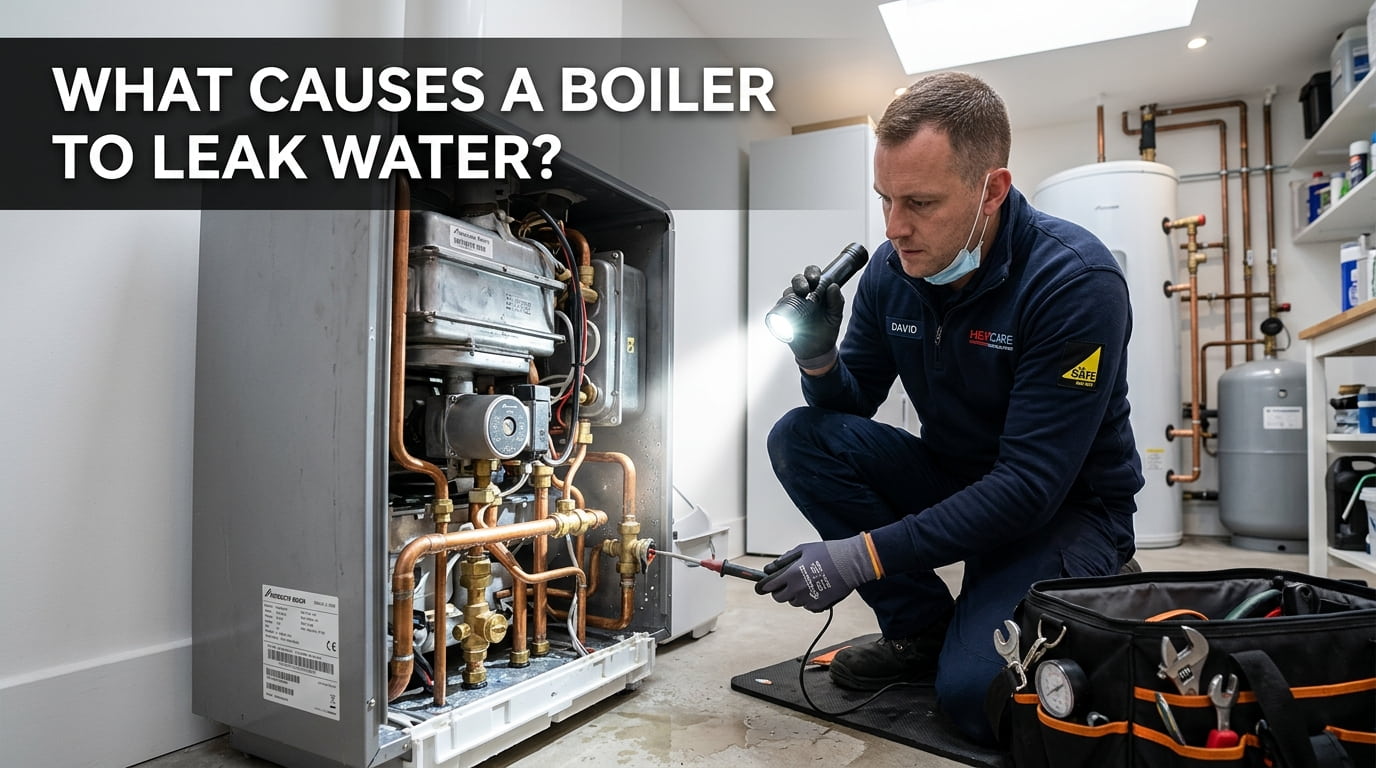

A boiler can leak water because of a deteriorated connection, a faulty component, pressure-related discharge or damage inside the equipment. On a condensing boiler, water may also escape from the condensate drainage system.
If you are asking, “Why is my boiler leaking water?”, the first useful clue is where the water appears. However, a puddle beneath the boiler does not establish which part has failed. Water can travel along pipes or inside the cabinet before reaching the floor.
Arrange a professional assessment rather than tightening fittings, adjusting pressure or repeatedly adding water.
What Should You Do First?
Keep people away from hot water, steam and wet electrical equipment.
If it is safe to reach a dry, clearly identified boiler shutdown control, follow the manufacturer’s shutdown instructions. Do not approach wet controls or stand in water to switch the equipment off.
Call a qualified technician and describe whether the leak is a slow drip, a steady flow or water coming from a discharge pipe.
If a carbon monoxide alarm sounds, leave the building immediately and call 911 from outside. Do not stay inside to investigate the boiler. cpsc.gov
A water leak alone does not establish a carbon monoxide problem, but an alarm requires an immediate response.
Possible Sources of Boiler Water Leaks
The following clues can help you describe the problem. They are not a substitute for diagnosis.
| Where water appears | Possible source | What to report |
|---|---|---|
| Around an exposed pipe connection | Joint, fitting or seal | Location and whether it drips continuously |
| At a relief-valve discharge pipe | Pressure issue or valve problem | When discharge occurs and any visible gauge reading |
| Around a circulating pump | Pump connection, gasket or component | Whether water appears during heating |
| Near an air vent on a hot-water system | Vent or surrounding connection | The visible location without touching it |
| Around condensate tubing | Drain connection, blockage or condensate pump issue | Whether the boiler is a condensing model |
| From beneath the cabinet | Internal component or water tracking from elsewhere | Amount of water and where it first becomes visible |
For help identifying the source, arrange an assessment through our boiler repair services in Bethlehem, PA.
Leaking Pipe Connections and Seals
Water may escape where pipes connect to the boiler or other heating components.
A technician may find a deteriorated gasket, corroded fitting or another connection problem. The repair depends on the material, component and condition of the surrounding pipework.
Do not assume that tightening a visible fitting will resolve the problem. Applying force to a hot or deteriorated connection can make the situation worse.
From a safe distance, note where the first visible droplets appear. A photograph of the exposed area can help explain the location when requesting service.
Water From the Pressure Relief Valve
The relief valve is a safety device. Water from its discharge pipe may indicate that it is responding to excessive pressure, or that the valve itself needs attention.
On a hot-water boiler system, an expansion tank problem can contribute to pressure rising as the water heats. Manufacturer guidance identifies inadequate expansion capacity as a possible cause of water loss through the relief valve. weil-mclain.com
The technician needs to assess the system rather than replace the valve without investigating why it discharged.
Never cap, plug or obstruct a relief-valve discharge pipe. Do not operate the valve as a troubleshooting test or adjust the system pressure yourself.
Pressure requirements differ between equipment types. Do not apply a generic online pressure recommendation to an unfamiliar boiler.
Leaks Around Pumps or Air Vents
Hot-water heating systems may have circulating pumps and air vents connected to the boiler or nearby piping.
Water around these components does not necessarily mean that the boiler body has failed. The source could be a component, its seal or an adjacent connection.
Report the visible location and whether the leak seems to occur during a heating cycle. Do not remove covers, touch hot components or loosen parts to investigate.
Steam boilers have different components and operating arrangements. Tell the service company which type of system you have, if known.
Condensate Drainage Problems
Condensing boilers produce condensate that must follow a designed drainage route.
Water escaping around condensate tubing or a condensate pump can involve a drainage fault rather than a leak from the heating-water circuit.
Do not assume that water on the floor is normal simply because the boiler is a condensing model. Normal condensate should remain within its intended drainage system.
Avoid disconnecting drain tubing or condensate traps. Ask the technician to identify the water source and inspect the relevant drainage arrangement.
Internal Damage or Corrosion
Water emerging from the cabinet may originate from an internal connection, seal or heat exchanger. It can also track into that area from another source.
The location of the puddle alone cannot establish whether a major component is damaged.
A qualified technician should identify the source and explain:
- Which component is leaking.
- Whether surrounding parts have been affected.
- Whether an appropriate repair is available.
- Whether suitable replacement parts can be obtained.
- What testing is needed after the work.
If substantial damage is confirmed, you can compare options using our guide to boiler repair vs replacement.
Could the Water Come From Somewhere Else?
Check the surrounding area visually without entering standing water or touching equipment.
Nearby sources can include plumbing pipes, another appliance or water entering the building. Water may run along a pipe before dripping beside the boiler.
Useful observations include:
- Whether pipes above the boiler are wet.
- Whether water appears when the heating is off.
- Whether another appliance is nearby.
- Whether the water follows rain or another household activity.
- Whether the wet area is spreading.
These observations help the technician investigate. They do not establish that the boiler is safe to keep running.
What Can a Homeowner Safely Record?
You can provide useful information without attempting a repair.
| Observation | Helpful detail |
|---|---|
| Leak timing | Continuous, intermittent or noticed during heating |
| Visible location | Pipe joint, discharge outlet, drain tubing or cabinet |
| Amount | Occasional drops, repeated puddling or steady flow |
| Display information | Error code or warning visible without opening covers |
| Gauge reading | Reading observed from a safe distance |
| Heating performance | Whether rooms are warming normally |
| Recent work | Maintenance, repairs or system changes |
Photograph the equipment label if it is safely accessible. The model information can help the service company prepare.
Do not repeatedly restart the boiler to reproduce the leak.
Do Not Treat Refilling as the Repair
Replacing lost water does not explain why the system is leaking.
Repeatedly adding water, resetting the boiler or drying the floor can conceal a continuing problem. These actions should not replace finding the source.
Avoid:
- Adjusting fill valves without professional guidance.
- Applying leak-sealing products.
- Tightening hot fittings.
- Opening the boiler cabinet.
- Blocking discharge pipes.
- Bypassing safety controls.
If the leak is accompanied by unusual sounds, our guide to a boiler making banging noises explains why the symptoms need assessment.
When Does a Leak Need Urgent Attention?
Seek prompt professional help when water is escaping steadily, reaching electrical equipment, emerging with steam or causing the boiler to stop heating.
For a Bethlehem home during cold weather, loss of heat adds urgency because the household may need a safe plan while repairs are arranged.
Tell the service company about the leak rate, any warning display and whether heat is available. Do not assume a small drip can wait indefinitely; it can still damage equipment or surrounding materials.
For a carbon monoxide alarm, fire or suspected gas emergency, leave the building and contact emergency services or the gas utility from a safe location.
FAQs
Is a small boiler leak normal?
An unexplained drip or puddle should be investigated. Condensing equipment produces water, but that water should follow its intended drainage route.
Can I keep running a leaking boiler?
Do not assume it is safe. Contact a qualified technician for advice based on the leak source and equipment condition. Shut down using the manufacturer’s instructions only when the control can be reached safely.
Does a leak mean I need a new boiler?
Not necessarily. A repairable connection or component may be responsible. Replacement is considered when the diagnosis identifies major damage or other reasons that make repair unsuitable.
Why does the boiler leak only while heating?
Heating can change temperature and system pressure, but several faults may produce that pattern. Report the timing without repeatedly operating the boiler to test it.
Should I top up the water or reset the boiler?
Do not use repeated refilling or resets as a workaround. Follow model-specific instructions and obtain professional guidance about the underlying fault.
Can I stop water coming from the relief pipe?
Never cap or block it. Keep clear of the discharge and have the valve and system assessed.
Find the Source Before Choosing the Repair
The visible leak location helps guide an inspection, but it does not prove which component has failed. Record what you can safely observe and let a qualified technician determine the cause.
For help assessing your heating equipment and planning the next step, explore our HVAC services in Bethlehem, PA.
You may also find useful: Why Is My Boiler Running but Not Heating the House? · When Is a Boiler Problem an Emergency? · How Much Does Boiler Repair Cost in Bethlehem, PA?