

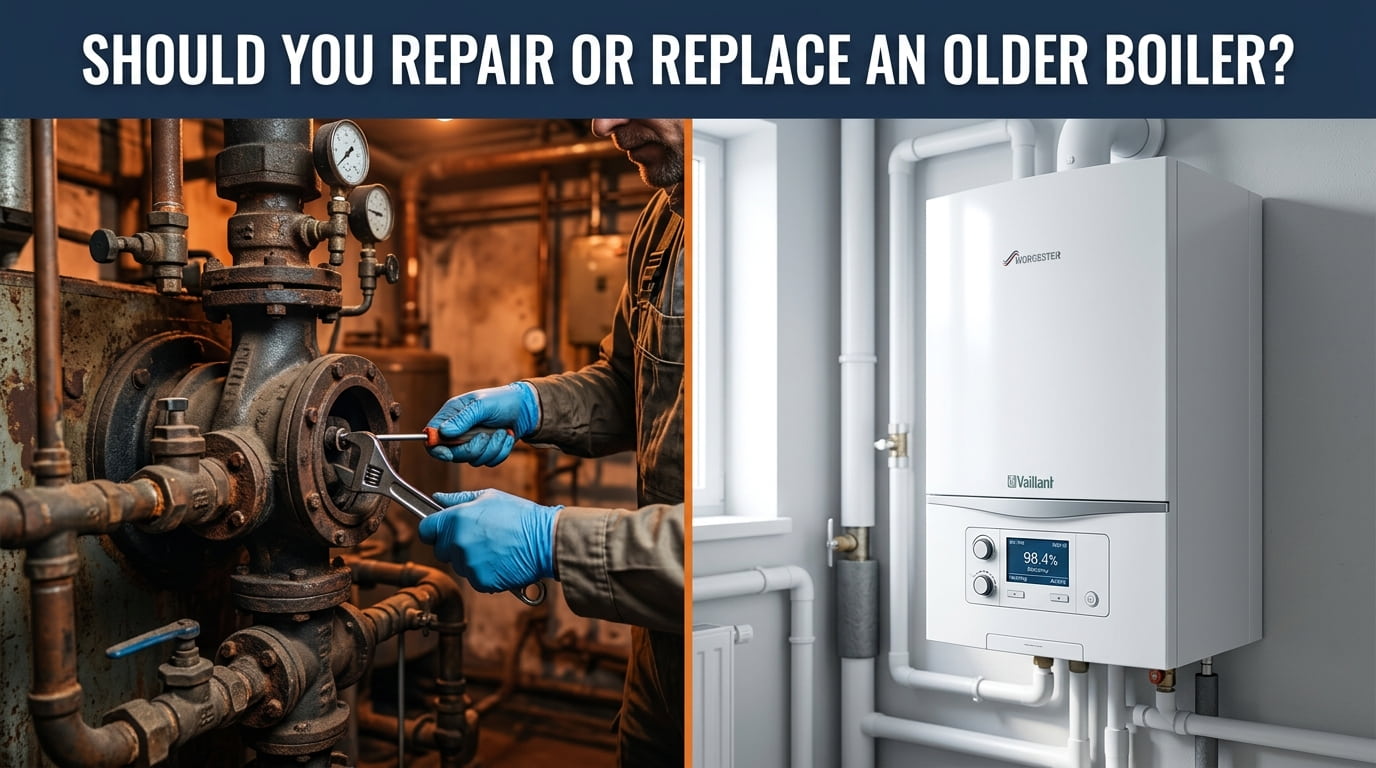

An older boiler does not automatically need replacing. Repair may be reasonable when the problem is isolated, suitable parts are available and a qualified technician confirms that the system can operate safely.
Replacement deserves closer consideration when major damage, repeated failures or substantial repair costs make continued investment difficult to justify.
The boiler repair vs replacement decision should compare the condition of the whole heating system, the likely value of the repair and the complete cost of installing suitable replacement equipment.
Start With a Diagnosis
A boiler that stops heating does not necessarily have a failed boiler body. The problem may involve controls, circulation equipment or another part of the heating system.
Before deciding, ask the technician to explain:
- Which component has failed.
- What caused the problem, where identifiable.
- Whether other significant defects were found.
- What the proposed repair includes.
- Whether suitable replacement parts are available.
- What testing will follow the repair.
A diagnosis helps you compare actual options rather than choosing between an unexplained repair bill and a replacement estimate.
Homeowners can arrange an assessment through our boiler repair services in Bethlehem, PA.
Treat Safety Problems Separately From Cost
A suspected safety issue needs attention before comparing repair prices.
If a carbon monoxide alarm sounds, leave the building immediately and call 911 from outside. Do not remain inside to investigate the boiler. The Consumer Product Safety Commission advises moving to fresh air and contacting emergency services when an alarm sounds or carbon monoxide poisoning is suspected. CPSC.gov
For other suspected boiler faults, ask a qualified technician whether the equipment can remain in operation while you consider the options. Do not assume that continued heating means the system is safe.
A safety defect does not always establish that replacement is the only solution. The diagnosis must determine whether a safe, appropriate repair is available.
When Repair May Be Worth Considering
Repair can be a sensible option when the fault is limited and the rest of the system remains serviceable.
| Finding | Why repair may remain reasonable |
|---|---|
| An isolated component failure | The problem may be resolved without replacing the complete boiler |
| Otherwise reliable operation | There may be little evidence of wider deterioration |
| Suitable parts are available | The repair can be completed using appropriate components |
| A clear repair scope | You can understand what the cost addresses |
| No major unresolved defects | The technician has not identified substantial additional work |
Ask what the repair is expected to resolve and what it leaves unchanged.
Replacing one component does not renew every other part of an older system. However, that alone is not a reason to discard equipment that is otherwise suitable.
When Replacement Deserves a Closer Look
Replacement may become more attractive when the assessment identifies substantial problems or the boiler has become difficult to support.
Reasons to compare replacement options include:
- Major deterioration or damage confirmed by the technician.
- Repeated breakdowns with different causes.
- Scarce or unavailable suitable parts.
- A substantial repair that leaves other serious concerns unresolved.
- Heating performance problems requiring a broader system review.
- An opportunity to improve efficiency as part of a planned upgrade.
Ask whether the proposed replacement addresses the actual problem. A new boiler may not resolve faults in existing piping, controls or heat distribution unless those are included in the work.
For replacement planning, explore our boiler installation services in Bethlehem.
Use Age as Context, Not the Entire Decision
Age is useful when reviewing service history and parts availability, but it does not describe the boiler’s condition by itself.
Two boilers of similar age may have different maintenance records, operating conditions and repair needs.
Instead of asking only how old the equipment is, ask:
- What condition is it in now?
- Which repairs have already been completed?
- Are failures recurring?
- Can the manufacturer or suppliers support the equipment?
- What would the proposed repair realistically achieve?
There is no single age at which every boiler should be replaced.
Compare the Complete Costs
A repair quote and an equipment-only replacement price are not equivalent.
Request an itemized replacement estimate that identifies what is included and what may require additional work.
| Cost category | What to clarify |
|---|---|
| Equipment | Proposed model and suitability for the home |
| Installation labor | Work included in the quoted price |
| Removal | Disposal of the existing equipment |
| Venting | Required alterations or replacement |
| Piping and controls | Components being changed or retained |
| Electrical work | Included connections and any separate work |
| Permits and inspections | Applicable requirements and who handles them |
| Commissioning | Startup, testing and system adjustments |
| Warranty | Equipment and labor coverage, including conditions |
For the repair option, confirm diagnostic charges, parts, labor and the warranty on the completed work.
Avoid treating an arbitrary percentage rule as the final answer. A repair costing a particular share of replacement may still be reasonable or poor value depending on what failed and the condition of the remaining system.
Assess Efficiency Without Assuming Guaranteed Savings
The Department of Energy describes annual fuel utilization efficiency, or AFUE, as a measure of how efficiently a boiler converts fuel into heat over a typical year. Department of Energy
A higher-rated replacement can offer an efficiency improvement, but the rating alone does not establish your future bill savings.
Ask the contractor to consider:
- The existing equipment’s condition and efficiency.
- Fuel type and local energy prices.
- How the home is heated and occupied.
- Controls and operating arrangements.
- Insulation and other building improvements.
- The suitability of the proposed installation.
Request the assumptions behind any savings estimate. Treat projected savings as an estimate rather than a promise.
Check Replacement Sizing and System Compatibility
Do not assume the new boiler should simply match the old unit’s capacity.
Changes to insulation, windows or the building can affect heating requirements. DOE guidance notes that building improvements can sometimes allow a smaller replacement system. www1.eere.energy.gov
Ask how the proposed size was determined and how the equipment will work with the existing heating system.
The quote should explain any necessary changes to controls, piping, venting or other components. These details affect both installation cost and the usefulness of the upgrade.
Consider Reliability and Disruption
The lowest immediate cost is only one part of the decision.
Repeated breakdowns may bring additional callouts, time without heat and disruption to the household. A planned replacement can provide more time to compare equipment and installation proposals.
On the other hand, a suitable repair may restore dependable operation without the expense of replacing the complete system.
For a Bethlehem homeowner facing a breakdown during cold weather, ask about repair availability, replacement scheduling and what safe arrangements are possible while work is planned. Do not assume temporary repair or replacement equipment is available until confirmed.
Questions to Ask Before Approving Work
Use these questions to compare the recommendations:
- What exactly has failed?
- Is the boiler safe to operate in its current condition?
- What does the repair resolve?
- Were other significant defects found?
- Are suitable parts available?
- What is included in the complete replacement price?
- How was the replacement size selected?
- Which existing components will remain?
- What warranty applies to each option?
- What assumptions support any projected savings?
For substantial work, another qualified opinion can help when the diagnosis or proposed scope remains unclear.
FAQs
Is an older boiler always worth replacing?
No. Condition, repair history, parts availability and the current fault matter alongside age. A qualified assessment should establish whether repair remains appropriate.
Should I replace a boiler after one expensive repair?
Not automatically. Compare what the repair would resolve, the condition of the remaining equipment and the complete replacement cost.
Will a new boiler fix uneven heating?
Not necessarily. Uneven heating may involve distribution, controls or other system issues. Ask whether the diagnosis and installation scope address those problems.
Can I compare options while the boiler keeps running?
Only if a qualified technician confirms that continued operation is appropriate. An operating boiler should not be assumed safe when a fault is suspected.
Does a higher AFUE rating guarantee lower bills?
It indicates higher rated fuel-conversion efficiency, but actual costs also depend on usage, fuel prices, installation and the home. Ask for a supported estimate.
What if the repair and replacement recommendations differ?
Ask each contractor to explain the diagnosis and scope in writing. Compare the same information rather than selecting solely on the final price.
Make the Decision From the Whole Assessment
Repair is most useful when it resolves a defined problem in an otherwise serviceable system. Replacement deserves closer consideration when condition, recurring failures or substantial work make continued investment less attractive.
For help assessing your heating system and planning the next step, explore our HVAC services in Bethlehem, PA.
You may also find useful: How Much Does Boiler Repair Cost in Bethlehem, PA? · HVAC Repair vs Replacement: How Should a Homeowner Decide? · What Causes a Boiler to Leak Water?