

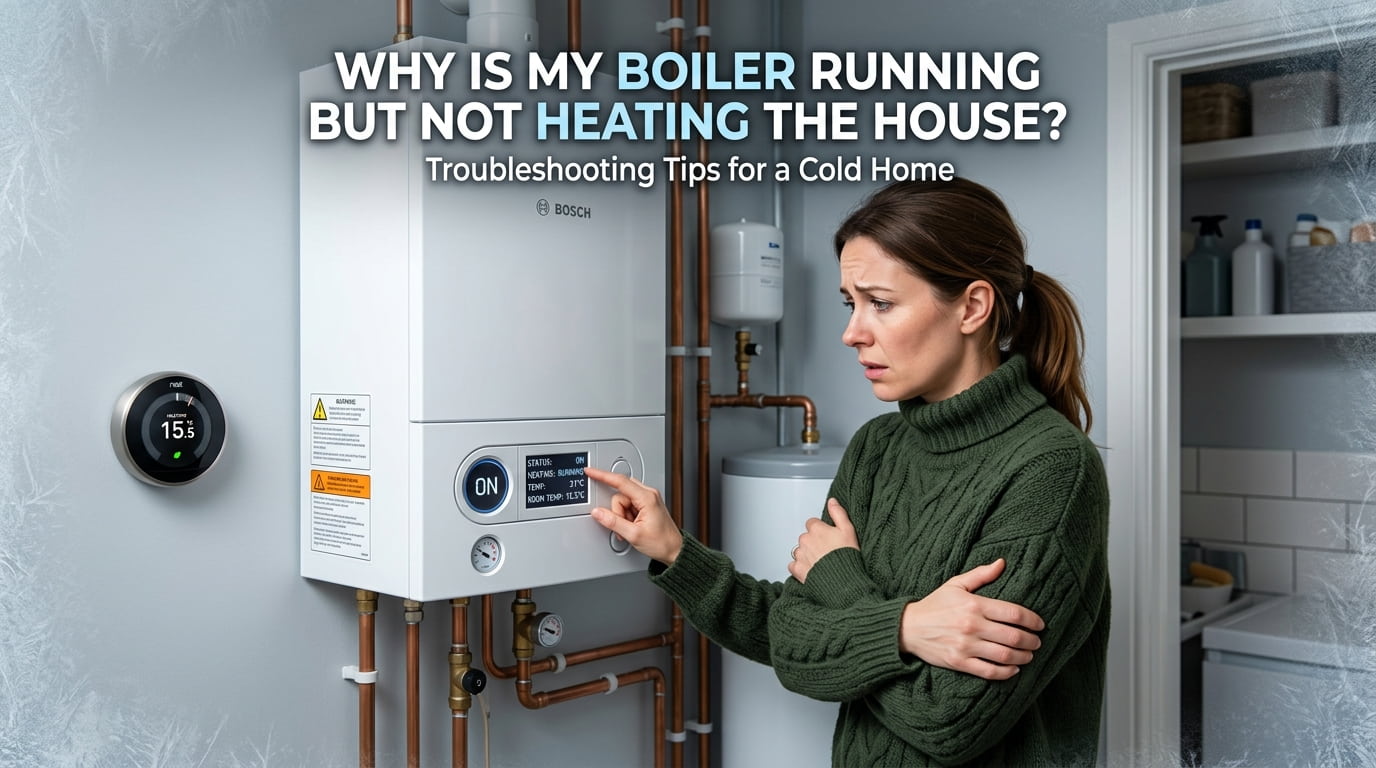

If your boiler appears to be running but your home remains cold, the problem may involve the thermostat, water pressure, circulation pump, zone controls, air trapped in the system or another component that prevents heat from reaching your rooms.
The boiler may be producing heat without circulating it correctly. In other cases, the display and controls may be powered even though the burner has not ignited.
Start with simple observations and safe homeowner checks. Do not remove the boiler cover, adjust gas components or attempt internal electrical repairs.
First, Determine What the Boiler Is Doing
“Running” can mean several different things. Before troubleshooting, check what you can see and hear without opening the boiler.
Ask these questions:
- Is the boiler display illuminated?
- Can you hear the burner operating?
- Is the boiler making its usual operating sound?
- Are the pipes near the boiler becoming warm?
- Are all radiators cold, or only some of them?
- Is one heating zone affected while another works?
- Is an error code visible?
- Does the thermostat show that it is requesting heat?
- Is the boiler producing domestic hot water but not heating the house?
These observations can help distinguish between a boiler that is not generating heat and one that is generating heat but not distributing it.
Common Reasons a Boiler Runs Without Heating the House
1. The thermostat is not requesting heat correctly
The thermostat controls when the heating system starts. Incorrect settings, depleted batteries, scheduling problems or a communication fault can prevent the boiler from receiving the correct heating request.
Check that:
- The thermostat is set to heating mode
- The target temperature is above the current room temperature
- A programmed schedule is not preventing operation
- The display is working
- The batteries are not depleted
- A smart thermostat is connected properly
Raise the temperature a few degrees and wait several minutes. Boiler systems do not always respond instantly.
If the thermostat appears active but the boiler does not respond, the thermostat, wiring or control system may require professional diagnosis.
2. The boiler is powered but the burner is not firing
A working display does not necessarily mean the boiler is producing heat. The electrical controls may be active while the burner remains off.
Possible causes include:
- Ignition failure
- Flame sensor problems
- Fuel supply interruption
- Safety lockout
- Control board faults
- Burner problems
- A blocked condensate system on an applicable boiler
Look for a flame indicator or error code described in the manufacturer’s manual. Do not open the casing or attempt to repair burner components.
If the boiler repeatedly attempts to ignite and shuts down, arrange professional boiler repair in Bethlehem, PA.
3. The system pressure is outside the correct range
Many hot-water boiler systems require adequate pressure to circulate heated water. If the pressure is too low, the boiler may stop heating or enter a safety mode.
The correct pressure varies by boiler and system design. Check the manufacturer’s manual rather than relying on a universal number.
Possible signs of a pressure problem include:
- A low reading on the pressure gauge
- An error code related to pressure
- Cold radiators
- Gurgling sounds
- A boiler that starts and stops
- Evidence of a water leak
Do not repeatedly add water without identifying why the pressure dropped. Recurring pressure loss may indicate a leak, expansion tank problem, pressure relief issue or another fault.
High pressure also requires attention. Do not drain or modify the system unless the manufacturer’s instructions clearly permit a homeowner procedure and you are confident you can perform it safely.
4. The circulation pump is not moving hot water
A hydronic boiler depends on a circulator pump to move heated water through the pipes, radiators or baseboard units.
If the boiler becomes hot but the house stays cold, circulation may be the problem.
A circulator can fail because of:
- Electrical failure
- A seized motor
- Worn internal components
- Air trapped near the pump
- Incorrect control signals
- Blocked or restricted water flow
You may notice that the boiler and nearby pipe are warm while pipes farther away remain cold.
Circulator pumps involve electricity and hot water. Testing or replacing one should be left to a qualified technician.
5. Air is trapped in the heating system
Air trapped in radiators or pipes can prevent hot water from circulating properly.
Common signs include:
- Cold areas near the top of a radiator
- Gurgling or bubbling sounds
- Some radiators heating while others remain cold
- Slow or uneven heating
Some systems allow radiators to be bled, but the correct procedure depends on the boiler, radiator and system pressure.
If you do not know how to restore the correct system pressure afterward, or if the system repeatedly collects air, call a technician. Recurring air can point to a leak, expansion issue or another system problem.
6. A zone valve is not opening
Homes with multiple heating zones use controls that direct hot water to selected areas. A failed zone valve can leave one floor or section cold while the rest of the house heats normally.
Signs of a possible zone problem include:
- One thermostat works while another does not
- One floor is cold but another is comfortable
- The boiler runs when one zone calls for heat
- Pipes leading to the affected area remain cold
Zone valve diagnosis usually involves electrical testing and should be handled by a heating professional.
7. Radiator or baseboard valves are closed
A closed valve can stop heat from reaching an individual radiator or baseboard section.
Check accessible heating valves to confirm they have not been accidentally turned off. Do not force a valve that is stuck.
If several radiators are affected, the problem is more likely to involve system circulation, pressure, zoning or the boiler itself.
8. Sludge or deposits are restricting circulation
Over time, corrosion and debris can collect inside a hydronic heating system. This buildup may restrict water flow and reduce heat output.
Possible signs include:
- Radiators that remain cold near the bottom
- Uneven heating throughout the home
- Noisy boiler operation
- Slow heating
- Repeated pump problems
- Some rooms taking much longer to warm
Cleaning a boiler system requires professional assessment. Adding chemicals without understanding the system can create further problems or conflict with manufacturer requirements.
9. The condensate line is frozen or blocked
Some high-efficiency condensing boilers produce condensate that drains through a pipe. During freezing weather, an exposed section of this line may freeze and cause the boiler to shut down.
An error code may indicate a condensate problem.
Do not use an open flame, boiling water or a heating device that could damage the pipe. Follow the boiler manufacturer’s instructions or contact a technician.
If the line repeatedly freezes, its routing or insulation may need correction.
10. The boiler is short cycling
Short cycling occurs when a boiler starts and stops repeatedly without completing a normal heating cycle.
Potential causes include:
- Thermostat problems
- Restricted circulation
- An oversized boiler
- Pump problems
- Incorrect control settings
- Overheating
- Scale or sludge
- A faulty temperature sensor
Short cycling can reduce comfort and place additional stress on system components. It should not be ignored if it continues.
Our guide explaining why an HVAC system keeps turning on and off covers additional cycling problems that may affect home heating systems.
What Homeowners Can Check Safely
You can perform a few basic checks without opening the boiler or touching fuel components.
Check the thermostat
Confirm that it is in heating mode and set above the current room temperature. Replace the batteries if necessary.
Check the electrical supply
Make sure the boiler’s service switch has not been turned off accidentally. Check whether the relevant circuit breaker has tripped.
If a breaker trips again after being reset once, leave it off and call a technician. Repeated breaker trips can indicate an electrical problem.
Read the boiler display
Write down any warning light or error code. Consult the manufacturer’s manual for its meaning.
The code can help a technician identify the problem more efficiently.
Look at the pressure gauge
Compare the reading with the range stated in the boiler manual. Do not assume that every boiler uses the same pressure.
Check which rooms are affected
Determine whether the whole house is cold or only one zone, floor or radiator. This helps separate boiler problems from circulation and zoning problems.
Look for visible leaks
Without removing panels, check the floor and visible pipes around the boiler for water.
Do not touch leaking water near electrical components. Turn the system off if it is safe to do so and arrange professional service.
Check accessible radiator valves
Confirm that accessible valves have not been closed. Never force a seized valve.
Try only the permitted reset procedure
Some boilers provide a homeowner reset function. Follow the manufacturer’s instructions and reset the boiler only as directed.
If it locks out again, stop resetting it. Repeated lockouts indicate an unresolved fault.
What You Should Not Attempt Yourself
Do not:
- Remove the boiler casing
- Repair gas or oil components
- Bypass a safety control
- Repeatedly reset a locked-out boiler
- Adjust burner settings
- Modify the pressure relief valve
- Repair internal electrical wiring
- Seal or obstruct a flue
- Use an open flame to thaw a pipe
- Continue operating a leaking boiler
- Ignore a carbon monoxide alarm
Internal boiler work requires appropriate training, tools and safety procedures.
When a Boiler Problem Is an Emergency
Leave the property and seek emergency assistance if:
- A carbon monoxide alarm sounds
- You smell gas
- You hear gas escaping
- Anyone experiences symptoms associated with possible carbon monoxide exposure
- Smoke or fire is present
- The boiler or nearby electrical components are sparking
- Water is leaking onto electrical equipment
Carbon monoxide is colorless and odorless. If a carbon monoxide alarm sounds, move everyone outside, call 911 and do not return until emergency responders say it is safe. The U.S. Consumer Product Safety Commission recommends professional inspection of home heating systems and working carbon monoxide alarms on every level of the home.
For urgent heating failures that do not involve an immediate gas, fire or carbon monoxide hazard, review the available emergency HVAC information.
Why Some Radiators Heat While Others Stay Cold
If some radiators work normally, the boiler is likely producing at least some heat.
The issue may involve:
- Air trapped in a radiator
- A closed valve
- A failed zone valve
- Poor system balancing
- Restricted pipes
- Sludge inside a radiator
- A weak circulation pump
A technician can check temperature differences, circulation and zone operation to locate the restriction.
Why the Boiler Produces Hot Water but No Heating
Some boilers provide both space heating and domestic hot water. If your taps have hot water but your radiators remain cold, the boiler may still be generating heat.
Possible causes include:
- A thermostat fault
- A heating control problem
- A failed zone valve
- A diverter valve problem
- A circulation pump fault
- Incorrect scheduling
- Restricted flow through the heating circuit
This symptom usually requires diagnosis of the controls and water circulation system.
Could the Boiler Be Too Small for the House?
An undersized boiler may run for long periods without reaching the thermostat setting, particularly during very cold weather.
However, poor performance does not automatically mean the boiler is too small. Heat loss, insulation, circulation, control settings and system maintenance can produce similar symptoms.
A proper assessment should consider:
- The size and layout of the home
- Insulation levels
- Window condition
- Boiler output
- Radiator or baseboard capacity
- Outdoor temperature
- System water flow
- Previous additions to the house
Do not replace a boiler based only on operating time. A heating load calculation and system inspection provide better evidence.
When Repair May No Longer Be Practical
Repair may remain the sensible option when the boiler has a limited, replaceable fault and is otherwise in good condition.
Replacement may deserve consideration when:
- The boiler requires frequent repairs
- Important components are no longer readily available
- Leaks or corrosion are extensive
- The system cannot heat the home consistently
- Energy use has increased significantly
- The boiler is approaching or exceeding its expected service life
- The repair cost is difficult to justify against replacement
ENERGY STAR suggests considering replacement when a furnace or boiler is more than 15 years old, although age alone does not determine whether replacement is necessary.
If replacement is being considered, review the available information about boiler installation in Bethlehem, PA.
How to Reduce Future Boiler Problems
Preventive maintenance can identify developing issues before a winter breakdown.
A professional boiler service may include checking:
- Thermostat operation
- Boiler controls
- Burner operation
- Gas or oil connections
- Combustion
- Flue and venting
- Circulation pump
- System pressure
- Expansion components
- Safety controls
- Visible leaks
- Radiator or zone performance
ENERGY STAR recommends checking thermostat settings and having fuel connections, burner combustion and heat exchangers professionally inspected.
Scheduling maintenance before the coldest part of the Bethlehem winter also allows time to address problems before the heating system is working at full demand.
You can learn more about available boiler services in Bethlehem, PA.
Final Answer
A boiler running but not heating the house usually indicates one of two situations. The boiler is not actually producing heat, or it is producing heat that is not circulating through the home.
Start by checking the thermostat, electrical supply, display, error codes, pressure gauge and which areas of the house are affected. Do not open the boiler, adjust fuel components or repeatedly reset a locked-out system.
If the problem continues, a professional technician should inspect the burner, controls, circulation pump, zone valves, pressure and water flow.
Internal link recommendations
| Anchor text | Destination |
|---|---|
| boiler repair in Bethlehem, PA | https://hvacbethlehempa.com/boiler-repair-bethlehem-pa/ |
| boiler installation in Bethlehem, PA | https://hvacbethlehempa.com/boiler-installation-bethlehem-pa/ |
| boiler services in Bethlehem, PA | https://hvacbethlehempa.com/boiler-services-bethlehem-pa/ |
| why an HVAC system keeps turning on and off | https://hvacbethlehempa.com/hvac-keeps-turning-on-and-off/ |
| emergency HVAC information | https://hvacbethlehempa.com/emergency-hvac/ |
FAQs
Why is my boiler running but all the radiators are cold?
The boiler may not be firing, or heated water may not be circulating. Common causes include low pressure, a failed circulator pump, a control problem, trapped air or closed valves.
Why are only some radiators getting warm?
This can result from trapped air, closed valves, poor system balancing, sludge, restricted water flow or a zone control problem.
Can I reset my boiler myself?
Use only the reset procedure provided in the manufacturer’s manual. If the boiler locks out again, do not continue resetting it. Arrange professional diagnosis.
Why does my boiler provide hot water but no central heating?
The issue may involve the thermostat, heating controls, diverter valve, zone valve or circulation pump. The boiler may still be generating heat but failing to direct it through the heating circuit.
Should I turn off a boiler that is not heating?
Turn it off if you see a leak, notice an electrical problem, smell gas or observe another unsafe condition. If you smell gas or a carbon monoxide alarm sounds, leave the property and call emergency services from outside.
How often should a boiler be serviced?
A professional annual inspection is generally recommended, ideally before the main heating season. Always follow the boiler manufacturer’s maintenance instructions.
You may also find useful: Why Is My Boiler Making Banging or Whistling Noises? · Why Is My HVAC System Running but Not Heating or Cooling? · How Much Does Boiler Repair Cost in Bethlehem, PA?