

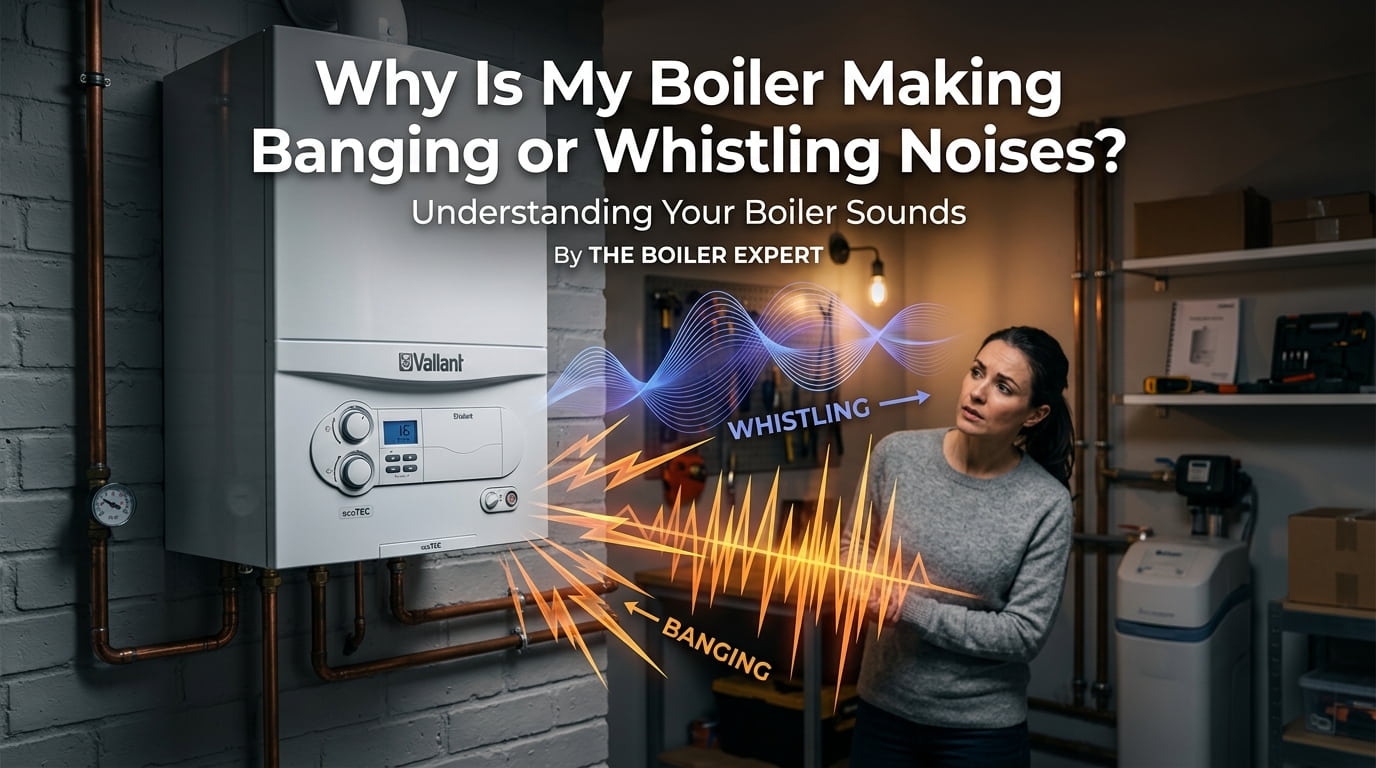

A boiler making banging noise may have trapped air, restricted water circulation, mineral buildup, incorrect system pressure, a circulation pump problem or another fault affecting normal operation.
Whistling or rumbling can sometimes indicate kettling, which happens when water inside the heat exchanger becomes excessively hot or cannot circulate properly. Banging from a gas boiler during ignition can indicate a different and potentially serious problem.
The sound, its location and when it occurs all matter. Do not remove the boiler cover or attempt to adjust fuel, burner or internal electrical components yourself.
Are Boiler Banging Noises Normal?
A boiler may make quiet operational sounds as it starts, heats water and circulates it through the system. Gentle clicking, a low hum and water movement may be normal for some models.
Loud or new sounds should be investigated, particularly if they include:
- Repeated banging
- Deep rumbling
- High-pitched whistling
- Knocking inside the boiler
- Gurgling in pipes or radiators
- Metallic rattling
- Screeching
- A loud bang during ignition
U.S. Boiler Company identifies gurgling, banging and whistling as signs that should be assessed by a heating professional.
What Different Boiler Noises May Mean
| Boiler sound | Possible causes |
|---|---|
| Banging inside the boiler | Kettling, restricted flow, pump problems or scale buildup |
| Loud bang during ignition | Delayed ignition or burner problem |
| Whistling | Kettling, restricted water flow or pressure problems |
| Gurgling | Trapped air, low pressure or circulation problems |
| Knocking in pipes | Pipe expansion, water hammer or circulation issues |
| Humming | Circulation pump, fan or electrical component |
| Rattling | Loose panels, pipe movement or worn components |
| Screeching | Pump, fan or pressure-related fault |
| Clicking without ignition | Ignition or control problem |
These are possible explanations, not a remote diagnosis. Different boiler types can produce similar sounds for different reasons.
Common Reasons a Boiler Makes Banging Noises
1. Kettling inside the boiler
Kettling is a common description for rumbling, banging or whistling that resembles a kettle boiling.
It can happen when water inside the heat exchanger becomes too hot because it is not moving through the system properly. Steam bubbles may form and collapse, creating noise.
Potential causes include:
- Mineral deposits
- Scale inside the heat exchanger
- Sludge in the system
- Restricted water flow
- A weak circulation pump
- Closed or restricted valves
- Incorrect system pressure
Kettling should not be ignored. Continued overheating can place additional stress on the boiler and its components.
A technician may need to inspect water flow, test the pump and assess whether the heat exchanger or heating system requires professional cleaning.
2. Air trapped in the heating system
Air inside pipes, radiators or baseboard units can interrupt water circulation and create gurgling, knocking or banging sounds.
Other signs may include:
- Cold spots on radiators
- Uneven heating
- Bubbling sounds
- Slow heating
- Some rooms remaining cold
- Pressure fluctuations
Some systems allow air to be removed from radiators. However, the correct procedure depends on the system type and pressure requirements.
If you are not familiar with your boiler’s instructions, or if trapped air keeps returning, arrange professional service. Repeated air buildup may indicate a leak, expansion problem or pressure issue.
3. Mineral or scale buildup
Homes with mineral-rich water may develop deposits inside boiler components over time.
Deposits can restrict the passage of water through the heat exchanger. Reduced flow can cause localized overheating, whistling and banging.
Possible signs include:
- Whistling that becomes louder as the boiler heats
- Rumbling inside the boiler
- Reduced heating performance
- Longer operating cycles
- Increasing energy use
- Repeated overheating or lockouts
Removing scale from a boiler is not a basic homeowner task. The correct cleaning method depends on the boiler material, manufacturer and type of deposit.
Using an unsuitable chemical can damage components or affect seals. A technician should determine whether cleaning is appropriate.
4. A circulation pump problem
The circulation pump moves heated water from the boiler through the home.
If the pump is weak, damaged or obstructed, water may not move quickly enough. The boiler can become hot while radiators or baseboards remain cool.
Pump problems may produce:
- Humming
- Vibration
- Grinding
- Banging
- Uneven heating
- Hot pipes near the boiler but cold pipes farther away
Circulation pumps involve both electricity and hot water. Testing, freeing or replacing the pump should be handled by a qualified technician.
If the boiler is running but the house remains cold, read our guide explaining why a boiler runs without heating the house.
5. Incorrect boiler pressure
Pressure outside the range specified by the manufacturer can affect boiler operation and circulation.
Low pressure may contribute to:
- Gurgling
- Poor circulation
- Cold radiators
- Boiler lockouts
- Reduced heating output
High pressure may cause:
- Noise
- Water discharge
- Leaks
- Stress on system components
- Pressure relief valve operation
Check the visible pressure gauge and compare it with the range in the boiler manual. Do not assume every boiler requires the same pressure.
Recurring pressure loss or excessive pressure requires professional diagnosis. Possible causes include leaks, expansion tank problems, pressure relief issues or filling system faults.
6. A problem with the expansion tank
A closed-loop hot-water heating system needs space for water to expand as it becomes hot. The expansion tank helps manage this pressure change.
If the expansion tank loses its air charge or develops an internal problem, system pressure can fluctuate.
Possible symptoms include:
- Banging
- Pressure rising significantly during heating
- Water released from the relief valve
- Repeated pressure problems
- Uneven circulation
- Boiler shutdowns
Expansion tank testing and adjustment should be performed by someone familiar with boiler pressure and safety controls.
7. Water hammer in the pipes
Water hammer occurs when moving water stops or changes direction suddenly, creating a noticeable bang or knock.
In a boiler system, this may relate to:
- Rapidly closing valves
- Circulation problems
- Incorrect pipe installation
- Unsupported pipes
- Steam or condensate movement
- Zone valve operation
The location and timing of the noise help identify the cause. A bang in a wall when a zone changes is different from a bang inside the boiler during ignition.
8. Pipes expanding against nearby materials
Heating pipes expand as their temperature rises. If a pipe passes tightly through wood, flooring or another building material, it may produce ticking, tapping or knocking.
This sound often:
- Begins as the system warms
- Comes from walls or floors
- Reduces after temperatures stabilize
- Returns as the system cools
Pipe expansion may be irritating without indicating a boiler failure. However, loud or worsening movement should be inspected to make sure the pipes are properly supported and not being damaged.
9. Delayed ignition
A loud bang when a gas boiler attempts to ignite requires prompt professional attention.
Delayed ignition may allow unburned gas to accumulate before ignition occurs. The resulting ignition can create a noticeable bang.
Possible contributing problems include:
- Dirty burner components
- Ignition system failure
- Incorrect combustion
- Fuel pressure problems
- Blocked burner ports
- Control faults
Do not continue resetting or restarting a boiler that bangs during ignition. Turn it off if it is safe to do so and arrange professional boiler repair in Bethlehem, PA.
If you smell gas or hear gas escaping, leave the property immediately. Contact emergency services or the gas utility from outside the building.
10. Steam boiler problems
Steam boilers can bang when steam and condensate meet inside the piping. This is sometimes associated with water hammer.
Possible causes include:
- Incorrectly pitched pipes
- Condensate that cannot return properly
- Failed steam traps
- Partially closed valves
- Excessive boiler water level
- Dirty boiler water
- Improper system operation
Steam systems operate differently from hot-water boilers. Do not apply hot-water boiler troubleshooting procedures to a steam system.
A technician experienced with steam heating should inspect persistent banging.
Why Is the Boiler Whistling?
A high-pitched whistling sound often points to restricted flow or localized overheating.
Possible causes include:
- Scale inside the heat exchanger
- Restricted valves
- A blocked section of pipe
- Circulation pump problems
- Incorrect system pressure
- Excessive water temperature
- Air moving through a restricted area
Whistling that becomes louder as the boiler heats may indicate kettling. The boiler may continue producing heat, but the underlying restriction can place additional strain on the system.
Do not attempt to solve the problem by changing internal boiler settings.
Why Is the Boiler Gurgling?
Gurgling commonly suggests air or an issue with water movement.
The sound may come from:
- The boiler
- Radiators
- Baseboard units
- Pipes
- The circulation pump
Possible causes include:
- Air trapped in the system
- Low water pressure
- Incomplete filling
- A circulation restriction
- A leak allowing air to enter
- A drainage or condensate problem
A small amount of water movement may be normal when the system begins operating. Persistent or loud gurgling accompanied by poor heating should be inspected.
Why Does the Boiler Hum or Vibrate?
A boiler may produce a gentle hum during normal operation. A new, loud or increasing hum can indicate a mechanical or electrical problem.
Possible sources include:
- Circulation pump
- Fan
- Transformer
- Motor
- Loose panel
- Pipe vibration
- Scale restricting water flow
You can observe where the sound is coming from without removing covers. Do not touch electrical parts or try to hold a vibrating component while the boiler is operating.
Safe Checks Homeowners Can Make
Observe when the sound occurs
Note whether the noise happens:
- During startup
- During ignition
- While the burner operates
- When a heating zone opens
- When the system shuts down
- Only when certain radiators heat
- During very cold weather
This information can help a technician narrow down the cause.
Check the thermostat
Confirm that the thermostat is set correctly and is not causing unusually frequent cycles.
Read the boiler display
Look for warning lights or error codes. Record the code and check the manufacturer’s manual.
Check the pressure gauge
Compare the reading with the manufacturer’s recommended range. Do not add or remove water unless the manual provides a clear homeowner procedure and you understand it.
Check for visible leaks
Look around the boiler and visible pipes without removing any panels.
Water near electrical components requires immediate attention. Do not touch wet wiring or equipment.
Check which radiators are affected
Identify whether:
- All radiators are cold
- Only one radiator is noisy
- One heating zone is affected
- Radiators have cold areas
- The boiler is hot but the house remains cold
Record the sound
A short audio or video recording may help a technician understand the problem, particularly if the noise is intermittent.
What You Should Not Do
Do not:
- Remove the boiler casing
- Adjust the burner
- Change gas pressure
- Bypass safety controls
- Open a pressure relief valve
- Repeatedly reset the boiler
- Add unapproved cleaning chemicals
- Force stuck valves
- Repair electrical wiring
- Continue operating a boiler that bangs during ignition
- Ignore gas odors or carbon monoxide alarms
Fuel-burning appliances require appropriate knowledge, tools and testing equipment. The Consumer Product Safety Commission advises homeowners not to service fuel-burning equipment without the necessary skills and recommends annual professional inspection of boilers, chimneys and vents.
When Should You Turn the Boiler Off?
Turn the boiler off if it is safe to do so and arrange service when:
- There is a loud bang during ignition
- Water is leaking near electrical components
- The boiler is overheating
- The pressure is outside the permitted range
- The relief valve is repeatedly discharging
- The boiler repeatedly locks out
- The noise is rapidly becoming louder
- There is visible smoke, scorching or sparking
- The sound is accompanied by a burning smell
Leave the property immediately if you smell gas, hear gas escaping or a carbon monoxide alarm sounds.
Do not try to locate the source of carbon monoxide. Move outside, call 911 and wait for emergency responders to confirm when it is safe to return.
Does a Noisy Boiler Always Need Replacement?
No. Many boiler noises result from repairable problems involving circulation, pressure, controls, pumps or deposits.
Replacement may be considered when:
- The boiler requires frequent repairs
- Corrosion is extensive
- Important components are unavailable
- The heat exchanger is seriously damaged
- The boiler cannot heat the home reliably
- Repair costs are difficult to justify
- The system is poorly matched to the property
Age alone does not determine whether a boiler must be replaced. Its condition, repair history, efficiency and the seriousness of the fault should all be considered.
If replacement becomes the practical option, review information about boiler installation in Bethlehem, PA.
Can Regular Maintenance Prevent Boiler Noise?
Maintenance cannot prevent every fault, but it can identify problems before they become severe.
Professional boiler maintenance may include checking:
- Burner operation
- Combustion
- Heat exchanger condition
- Circulation pump
- System pressure
- Expansion components
- Safety controls
- Electrical connections
- Valves
- Chimney and venting
- Signs of corrosion or leakage
The CPSC recommends annual professional inspection of fuel-burning heating systems, including boilers, chimneys, flues and vents.
You can learn more about available boiler services in Bethlehem, PA.
Final Answer
A boiler making banging noise may have trapped air, restricted water flow, scale buildup, incorrect pressure, a circulation pump problem or water hammer.
A whistling or rumbling sound may indicate kettling. A loud bang during ignition may indicate a burner or delayed ignition problem and requires prompt professional attention.
Observe when the sound happens, record any error code and check the visible pressure gauge against the manufacturer’s instructions. Do not open the boiler, adjust fuel components or repeatedly reset it.
Persistent, loud or worsening noises should be inspected before they lead to loss of heat or additional boiler damage.
Internal link recommendations
| Anchor text | Destination |
|---|---|
| boiler repair in Bethlehem, PA | https://hvacbethlehempa.com/boiler-repair-bethlehem-pa/ |
| boiler services in Bethlehem, PA | https://hvacbethlehempa.com/boiler-services-bethlehem-pa/ |
| boiler installation in Bethlehem, PA | https://hvacbethlehempa.com/boiler-installation-bethlehem-pa/ |
| why a boiler runs without heating the house | https://hvacbethlehempa.com/boiler-running-but-not-heating/ |
FAQs
Is a banging boiler dangerous?
Some causes are less urgent than others, but loud banging should not be ignored. A bang during ignition, gas odor, carbon monoxide alarm, overheating or water near electrical components requires immediate action.
What is boiler kettling?
Kettling describes rumbling, banging or whistling associated with localized overheating or restricted water flow inside a boiler. Scale, sludge and circulation problems can contribute to it.
Can low boiler pressure cause banging?
Incorrect pressure can affect circulation and contribute to gurgling, knocking or poor heating. Compare the pressure with the range specified in the manufacturer’s manual.
Why does my boiler bang when it starts?
Banging at startup may relate to water movement, pipe expansion or ignition. A loud bang at the moment of gas ignition requires professional inspection.
Can trapped air make a boiler noisy?
Yes. Trapped air can cause gurgling, bubbling, knocking and uneven heating. Recurring air may indicate a leak, pressure issue or expansion problem.
Should I continue using a whistling boiler?
A persistent whistle may indicate kettling, restricted flow or another fault. Arrange an inspection rather than allowing the boiler to continue operating indefinitely without diagnosis.
You may also find useful: What Causes a Boiler to Leak Water? · When Is a Boiler Problem an Emergency? · How Much Does Boiler Repair Cost in Bethlehem, PA?