

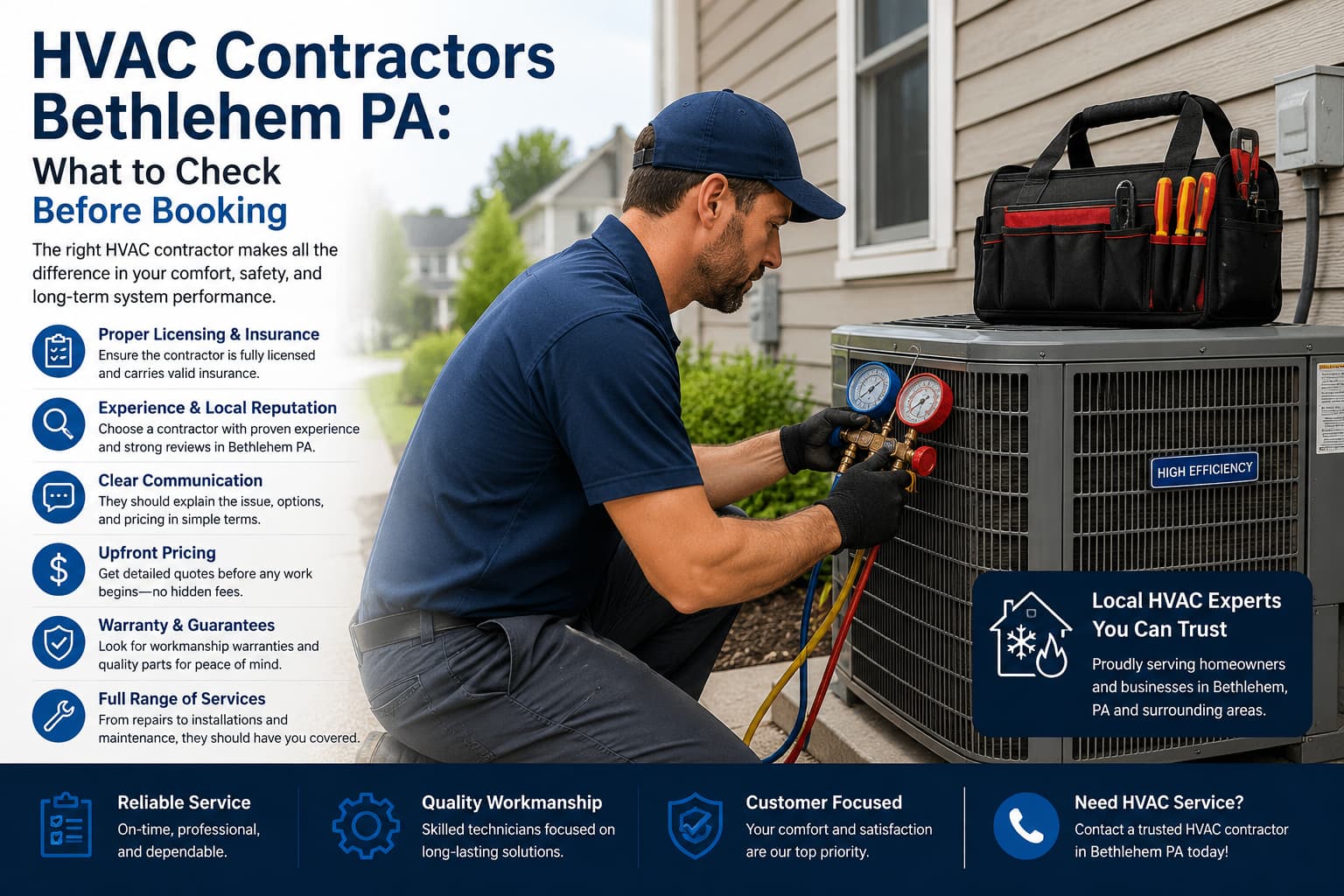

Choosing between HVAC contractors Bethlehem PA homeowners and businesses find online is not always straightforward.
Several companies may appear to offer similar heating and cooling services. The difference often becomes clearer when you look at how they communicate, inspect the system and explain the work that may be needed.
Before booking an HVAC contractor, it helps to know what to check.
Check Whether the Contractor Handles the Service You Actually Need
Not every HVAC call is the same.
You may need help with:
- a system that is not heating properly
- weak cooling
- unusual HVAC noises
- inconsistent room temperatures
- equipment replacement
- a new HVAC installation
If you are unsure where the problem fits, start by reviewing the available HVAC services in Bethlehem, PA.
A system that has stopped working may need HVAC repair in Bethlehem, PA, while an older or repeatedly failing system may lead to a discussion about HVAC installation.
The goal is not to diagnose the entire system yourself.
You should simply be able to explain what you are experiencing and receive a clear response.
Look for Clear Communication Before the Visit
The booking experience can tell you a lot.
A contractor should be able to explain what information they need from you.
They may ask:
- what the system is doing
- when the problem started
- whether heating or cooling has stopped completely
- whether you have noticed unusual sounds or smells
- what type of property needs service
These questions help create context before the visit.
Be cautious when the conversation immediately jumps to a major replacement without anyone understanding the problem.
A proper HVAC decision usually starts with the actual system condition.
Ask What the Inspection May Involve
A service visit should be more than a quick glance at the thermostat.
The exact checks depend on the problem, but the contractor may need to review system operation, airflow, visible components or other parts connected with the complaint.
For example, a system that is running but not cooling properly may have a different issue from a system that will not start at all.
Cooling problems may need a closer look at the air conditioning repair side of the system.
Heating problems may instead point towards heating repair or the furnace.
You do not need a long technical explanation before booking.
However, the contractor should be able to explain that the system needs to be checked before the correct repair or next step can be confirmed.
Make Sure the Explanation Is Easy to Understand
HVAC systems can be technical.
That does not mean the explanation should leave you more confused.
After checking the equipment, the contractor should be able to explain:
- what they found
- what may be causing the problem
- what work is being recommended
- whether the issue appears urgent
- whether other options should be considered
You may still need to make a technical decision, but the explanation should be understandable.
A customer should not feel pressured simply because unfamiliar HVAC terms are being used.
Be Careful With Instant Replacement Recommendations
Sometimes HVAC replacement is the right decision.
Older equipment, repeated breakdowns or major system problems may make installation worth considering.
But not every repair call should automatically become a replacement quote.
If a system can reasonably be repaired, the options should be explained.
If replacement is recommended, ask why.
For example:
- Is the current system failing repeatedly?
- Is a major component damaged?
- Is the equipment condition affecting reliability?
- Are repair costs becoming difficult to justify?
The answer should relate to your actual HVAC system.
If a cooling system is reaching the end of its usable life, the conversation may move towards AC installation in Bethlehem, PA.
For heating equipment, the next step may involve heating installation or furnace replacement planning.
The recommendation should follow the condition of the system, not a standard sales script.
Check How the Contractor Handles Residential and Commercial Work
Homes and business properties can have different HVAC needs.
A homeowner may be concerned about bedrooms not cooling evenly or the heating system stopping overnight.
A business may be dealing with uncomfortable staff areas, customer spaces or equipment serving a larger property.
When comparing HVAC contractors in Bethlehem, check whether the contractor understands the type of property you need serviced.
Commercial HVAC work can involve different equipment and operating requirements.
The contractor should not treat every property as though the system is identical.
Local Service Knowledge Can Be Useful
Working with an HVAC contractor familiar with Bethlehem and the surrounding area can make communication easier.
Local contractors regularly deal with heating and cooling needs connected with properties in the area.
This does not mean you should choose a contractor only because they use the word “local.”
You should still review the actual service, communication and approach.
A local HVAC company in Bethlehem, PA should make it clear what services are available and how homeowners or businesses can request help.
Ask About the Next Step Before Approving Work
Before work begins, you should understand what happens next.
Depending on the issue, that might mean:
- completing a repair
- arranging a part
- discussing equipment replacement
- scheduling installation
- reviewing another system concern
You should know what you are agreeing to.
If additional problems are discovered, they should be explained rather than silently added to the job.
Clear expectations reduce confusion for both the customer and contractor.
Do Not Choose Based on the Lowest Price Alone
Price matters.
However, the cheapest initial option is not always the clearest or most suitable choice.
A low quote may be attractive, but customers should still understand what is included.
Ask whether the proposed work addresses the problem that was actually found.
Likewise, a higher price does not automatically mean better HVAC service.
The decision should consider:
- system findings
- recommended work
- communication
- the type of service required
- what is included
Comparing the complete recommendation is more useful than comparing one number without context.
Watch for Pressure and Vague Claims
You should be cautious when a contractor uses pressure without clearly explaining the HVAC problem.
Examples may include being told that immediate major work is required without a proper inspection or receiving vague statements that the entire system is “bad” with little further explanation.
Some HVAC issues genuinely need quick attention.
However, urgency should still be connected with a specific problem.
Ask what was found and why the recommended action matters.
A clear contractor should be able to explain the reason.
When Should You Book an HVAC Contractor?
You should consider calling for HVAC service when your system is no longer performing normally.
Common reasons include:
- no heating
- no cooling
- weak airflow
- unusual system noises
- uneven temperatures
- repeated system shutdowns
- increasing difficulty keeping the property comfortable
A furnace that stops heating may need furnace repair in Bethlehem, PA.
If the furnace is older or repeatedly breaking down, furnace installation may eventually become part of the discussion.
Waiting for the system to stop completely is not always necessary.
If something has noticeably changed, an inspection may help identify what is happening before the problem becomes more disruptive.
Choosing an HVAC Contractor in Bethlehem, PA
The right contractor should make the process easier to understand.
You should be able to explain the HVAC problem, arrange a visit and receive a clear explanation of what was found.
Before booking, check whether the contractor handles the service you need, understands your type of property and is willing to explain the recommended work.
For heating and cooling support, review our HVAC services in Bethlehem, PA to find the repair or installation service that best matches the problem you are experiencing or visit Hvac Bethlehem PA.
The aim is to get the right system checked and understand the next step before work moves forward.